Pages

Sunday, May 16, 2010

DNA PROFILING


DNA profiling is a technique employed by forensic scientists to assist in the identification of individuals on the basis of their respective DNA profiles. DNA profiles are encrypted sets of numbers that reflect a person's DNA makeup, which can also be used as the person's identifier. DNA profiling should not be confused with full genome sequencing. It is used in, for example, parental testing and rape investigation.

Although 99.9% of human DNA sequences are the same in every person, enough of the DNA is different to distinguish one individual from another.DNA profiling uses repetitive sequences that are highly variable,called variable number tandem repeats (VNTR). VNTRs loci are very similar between closely related humans, but so variable that unrelated individuals are extremely unlikely to have the same VNTRs.

The DNA profiling technique was first reported in 1984 by Sir Alec Jeffreys at the University of Leicester in England,and is now the basis of several national DNA databases. Dr. Alec Jeffrey's genetic fingerprinting was made commercially available in 1987, when a chemical company, ICI, started a blood-testing center in England.

GENETIC CODE


Genes generally express their functional effect through the production of proteins, which are complex molecules responsible for most functions in the cell. Proteins are chains of amino acids, and the DNA sequence of a gene is used to produce a specific protein sequence. This process begins with the production of an RNA molecule with a sequence matching the gene's DNA sequence, a process called transcription.

This messenger RNA molecule is then used to produce a corresponding amino acid sequence through a process called translation. Each group of three nucleotides in the sequence, called a codon, corresponds to one of the twenty possible amino acids in protein – this correspondence is called the genetic code. The flow of information is unidirectional: information is transferred from nucleotide sequences into the amino acid sequence of proteins, but it never transfers from protein back into the sequence of DNA—a phenomenon Francis Crick called the central dogma of molecular biology.
The dynamic structure of hemoglobin is responsible for its ability to transport oxygen within mammalian blood.
A single amino acid change causes hemoglobin to form fibers.

The specific sequence of amino acids results in a unique three-dimensional structure for that protein, and the three-dimensional structures of protein are related to their function.Some are simple structural molecules, like the fibers formed by the protein collagen. Proteins can bind to other proteins and simple molecules, sometimes acting as enzymes by facilitating chemical reactions within the bound molecules (without changing the structure of the protein itself). Protein structure is dynamic; the protein hemoglobin bends into slightly different forms as it facilitates the capture, transport, and release of oxygen molecules within mammalian blood.

A single nucleotide difference within DNA can cause a single change in the amino acid sequence of a protein. Because protein structures are the result of their amino acid sequences, some changes can dramatically change the properties of a protein by destabilizing the structure or changing the surface of the protein in a way that changes its interaction with other proteins and molecules. For example, sickle-cell anemia is a human genetic disease that results from a single base difference within the coding region for the ß-globin section of hemoglobin, causing a single amino acid change that changes hemoglobin's physical properties.Sickle-cell versions of hemoglobin stick to themselves, stacking to form fibers that distort the shape of red blood cells carrying the protein. These sickle-shaped cells no longer flow smoothly through blood vessels, having a tendency to clog or degrade, causing the medical problems associated with this disease.

Some genes are transcribed into RNA but are not translated into protein products—these are called non-coding RNA molecules. In some cases, these products fold into structures which are involved in critical cell functions .RNA can also have regulatory effect through hybridization interactions with other RNA molecules

MOLECULAR GENETICS

Although genes were known to exist on chromosomes, chromosomes are composed of both protein and DNA—scientists did not know which of these is responsible for inheritance. In 1928, Frederick Griffith discovered the phenomenon of transformation dead bacteria could transfer genetic material to "transform" other still-living bacteria. Sixteen years later, in 1944, Oswald Theodore Avery, Colin McLeod and Maclyn McCarty identified the molecule responsible for transformation as DNA.The Hershey-Chase experiment in 1952 also showed that DNA (rather than protein) is the genetic material of the viruses that infect bacteria, providing further evidence that DNA is the molecule responsible for inheritance.

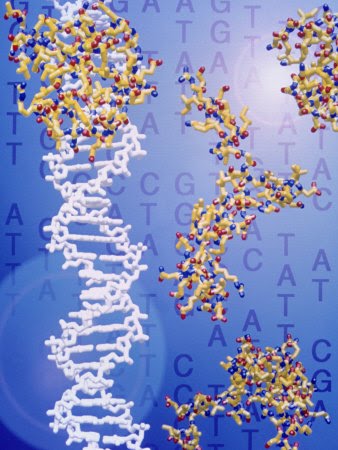
James D. Watson and Francis Crick determined the structure of DNA in 1953, using the X-ray crystallography work of Rosalind Franklin and Maurice Wilkins that indicated DNA had a helical structure (i.e., shaped like a corkscrew). Their double-helix model had two strands of DNA with the nucleotides pointing inward, each matching a complementary nucleotide on the other strand to form what looks like rungs on a twisted ladder.This structure showed that genetic information exists in the sequence of nucleotides on each strand of DNA. The structure also suggested a simple method for duplication: if the strands are separated, new partner strands can be reconstructed for each based on the sequence of the old strand.

Although the structure of DNA showed how inheritance works, it was still not known how DNA influences the behavior of cells. In the following years, scientists tried to understand how DNA controls the process of protein production. It was discovered that the cell uses DNA as a template to create matching messenger RNA (a molecule with nucleotides, very similar to DNA). The nucleotide sequence of a messenger RNA is used to create an amino acid sequence in protein; this translation between nucleotide and amino acid sequences is known as the genetic code.

With this molecular understanding of inheritance, an explosion of research became possible. One important development was chain-termination DNA sequencing in 1977 by Frederick Sanger: This technology allows scientists to read the nucleotide sequence of a DNA molecule. In 1983, Kary Banks Mullis developed the polymerase chain reaction, providing a quick way to isolate and amplify a specific section of a DNA from a mixture.Through the pooled efforts of the Human Genome Project and the parallel private effort by Celera Genomics, these and other techniques culminated in the sequencing of the human genome in 2003.

GENETICS


The fact that living things inherit traits from their parents has been used since prehistoric times to improve crop plants and animals through selective breeding. However, the modern science of genetics, which seeks to understand the process of inheritance, only began with the work of Gregor Mendel in the mid-nineteenth century. Although he did not know the physical basis for heredity, Mendel observed that organisms inherit traits via discrete units of inheritance, which are now called genes.

Genes correspond to regions within DNA, a molecule composed of a chain of four different types of nucleotides—the sequence of these nucleotides is the genetic information organisms inherit. DNA naturally occurs in a double stranded form, with nucleotides on each strand complementary to each other. Each strand can act as a template for creating a new partner strand—this is the physical method for making copies of genes that can be inherited.

The sequence of nucleotides in a gene is translated by cells to produce a chain of amino acids, creating proteins—the order of amino acids in a protein corresponds to the order of nucleotides in the gene. This relationship between nucleotide sequence and amino acid sequence is known as the genetic code. The amino acids in a protein determine how it folds into a three-dimensional shape; this structure is, in turn, responsible for the protein's function. Proteins carry out almost all the functions needed for cells to live. A change to the DNA in a gene can change a protein's amino acids, changing its shape and function: this can have a dramatic effect in the cell and on the organism as a whole.